
The platform For Canadian banks, insurers and credit unions
OSFI E‑23 model risk management software, enforced, not only recorded.
MINERVA keeps every model in E‑23’s fields, refuses approvals that break the rules you set, and gives your examiner evidence they can verify without trusting us. E‑23 takes effect on 1 May 2027.
01 What E‑23 asks, and what the platform does
Each row is a part of OSFI’s guideline in plain words, beside what MINERVA does about it today. The guideline itself is explained in our plain-language E‑23 guide.
| What E‑23 asks | What MINERVA does |
|---|---|
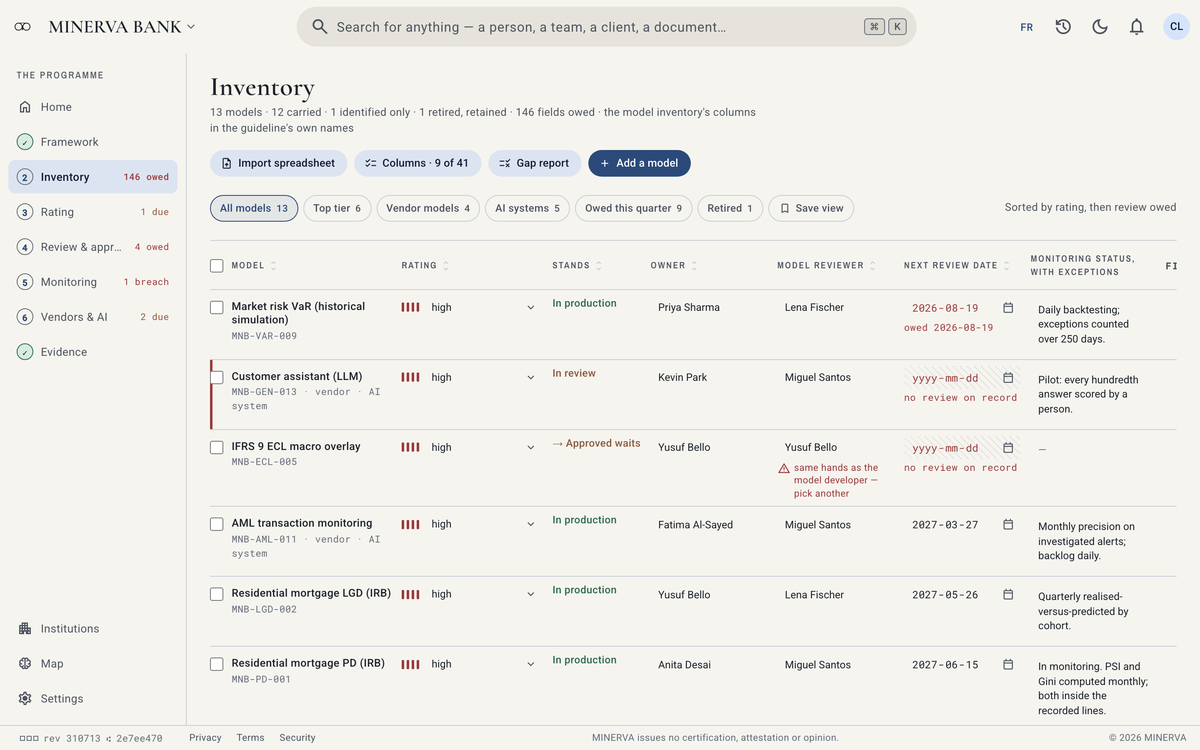
| One model inventory, in the guideline's own fields | Import the spreadsheet you already keep (CSV or Excel), map its columns to E‑23's fields in the browser, and see every field still owed, model by model. Vendor models and AI systems sit in the same inventory. |
| A risk rating for every model, driving the work | Each model is rated, and its tier sets how often it is reviewed, monitored and revalidated. A rating change is proposed and decided, never edited over. |
| Review independent of development | The reviewer must hold the review role or stand in the second line. The model's developer is refused as its reviewer or approver at the moment of decision, by name and by account. |
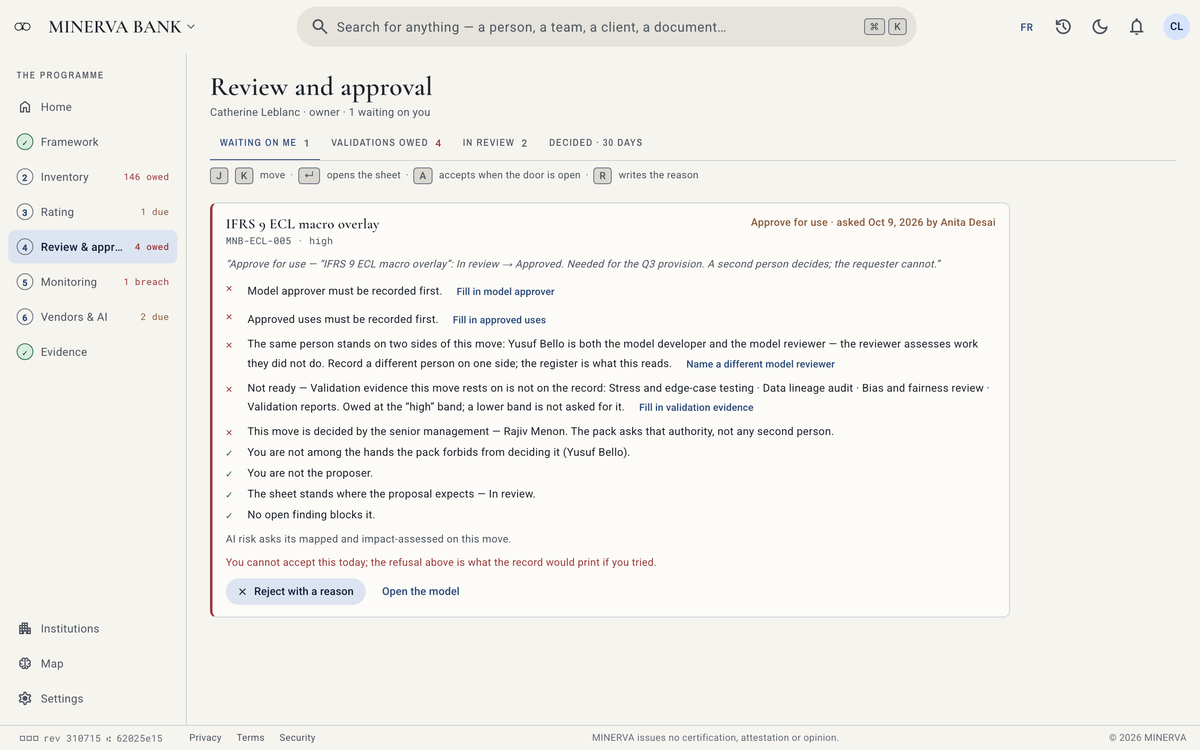
| Approval only with the evidence on file | Approval stays blocked until the validation evidence its tier calls for is recorded and no high-severity finding is open. The decision card lists each blocker beside what resolves it. |
| Validation results behind each approval | A Python SDK runs validation suites (performance, stability, calibration, backtesting, fairness and more) in your own environment, where the data stays, and records each result against the model. |
| Monitoring with thresholds and escalation | Each production model carries its watched figures and their lines. On a breach the system proposes the next step, such as a return to review, and a named person decides. |
| Third-party models and suppliers | Every supplier, the models that depend on it and the date each is owed a reassessment, read against OSFI B‑10 on the same record. |
| AI models and AI agents | Machine-learning and generative AI models are asked for explainability, retraining triggers and human oversight; AI agents run under written policies with held calls and a kill switch. |
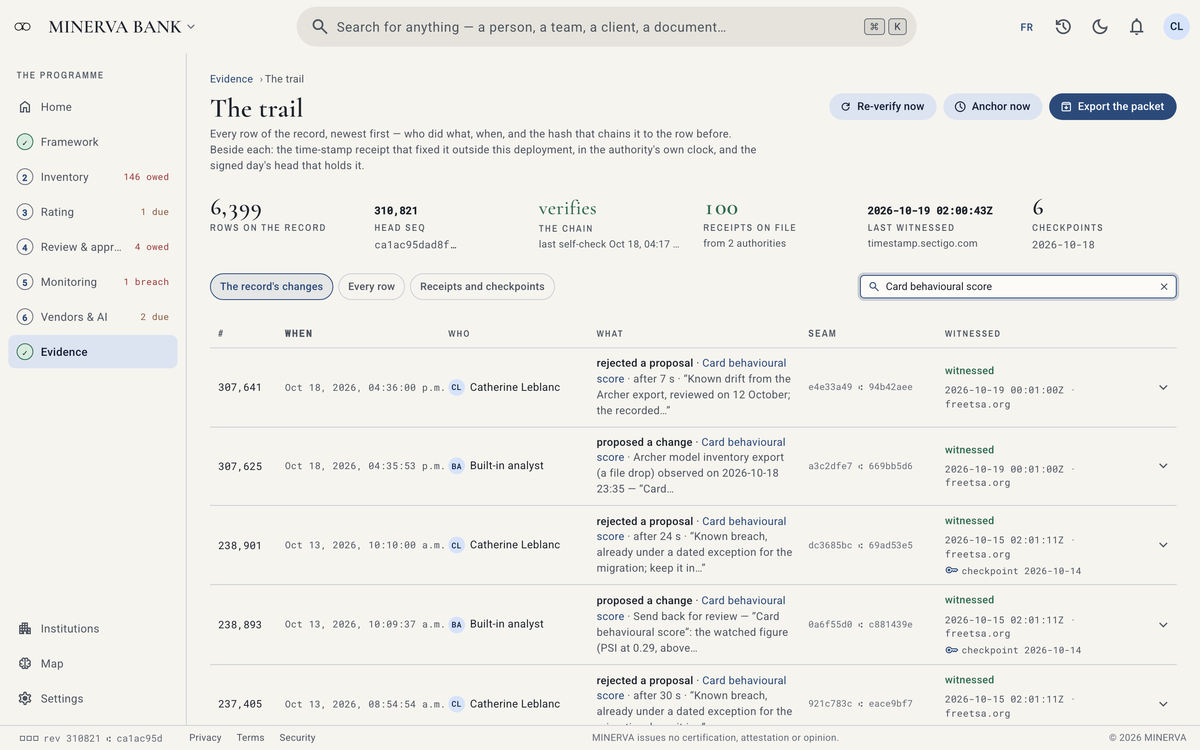
| Proof for the examiner | Every change is attributed, hash-chained and time-stamped by two independent time-stamp authorities. One export carries the evidence and a verifier the examiner runs offline, and a read-only examiner login is time-boxed. |
02 The programme in seven steps
- Framework
- Record the policy, the roles, the lines of defence and who holds approval authority.
- Inventory
- Bring in the spreadsheet; every model gets an owner, a developer, a reviewer and an approver.
- Rating
- Rate each model; the tier sets its review, monitoring and validation cadence.
- Review and approval
- Validation is recorded, the independent review signed, and approval decided by the right person.
- Monitoring
- Watched figures against their lines; breaches proposed back to review.
- Vendors
- Suppliers assessed and reassessed; their models and the models that depend on them in view.
- Evidence
- The gap report, the board report, model dossiers and the evidence packet, produced from the record.
03 Deployment, access and reports
- Where it runs
- On MINERVA's cloud, hosted in Canada, or on your own servers in your data centre. The same product either way.
- Sign-in
- Single sign-on through your identity provider, two-factor authentication and role-based access, with examiners and auditors as time-boxed, read-only users.
- Your systems
- Connectors read exports from model registries (a file drop, MLflow, Databricks Unity Catalog, SAS Model Manager, SageMaker), and an open API with scoped tokens reads and writes the same record.
- Reports
- PDF, Word, Markdown, web page and CSV, each printed from the record with the trail's head on it.
- Languages
- English and French.
04 Pricing
- Pilot
- 30 days on your real inventory, CAD 15,000, credited to year one.
- Subscription
- CAD 36,000 to 150,000 a year by the size of the register, seats unlimited: validators, auditors, examiners and vendors included.
- More rule packs
- CAD 12,000 a year each, on the same engine, such as NIST AI RMF and ISO/IEC 42001, the EU AI Act high-risk tier, US SR 26‑2, PRA SS1/23.
05 What it does not do
MINERVA does not make an institution compliant, issue a certification or replace the independent reviewer’s judgement. It does not host model validation compute: tests run where your data is and their results are recorded. Questions to ask us and every other vendor are in our buyer’s guide.
06 Questions people ask
What is OSFI E-23 software?
Software that helps a federally regulated institution run the model risk management programme OSFI's Guideline E-23 expects from 1 May 2027: a model inventory, a risk rating for each model, independent review and approval, monitoring, coverage of third-party and AI models, and records an examiner can check. E-23 is principles-based and requires no particular tool; many institutions start from spreadsheets.
How do we choose an OSFI E-23 platform?
Run it on your own inventory before you buy: import your spreadsheet, rate a model, send it for independent review, try to approve it with evidence missing, and export what your examiner would see. OSFI approves no platform. Our side-by-side of SAS Model Risk Management, IBM OpenPages, ValidMind, Yields, ModelOp, Lumenova AI, Mitratech ClusterSeven and MINERVA is at minerva.studio/osfi-e-23-software-comparison.
Does MINERVA make an institution E-23 compliant?
No software can. MINERVA keeps the record and enforces the controls the institution sets: it refuses a developer's own approval, holds approvals until the evidence is on file and keeps a trail an examiner can verify. Whether the programme meets E-23 is the institution's judgement and OSFI's.
Is MINERVA approved by OSFI?
OSFI does not approve or endorse software. MINERVA issues no certification or attestation; it keeps evidence the institution and its examiners judge for themselves.
Can we import our existing model inventory?
Yes. The spreadsheet you already keep, in CSV or Excel, is read in the browser, its columns are mapped to E-23's fields, and the gap report names every field still owed. A free E-23 inventory template is at minerva.studio/osfi-e-23/inventory-template.csv.
Does MINERVA validate our models?
Its Python SDK runs validation suites in your own environment, where the data stays, and records every result against the model and the approval it supports. MINERVA does not host model validation compute, and the independent reviewer still signs the validation.
Does it cover third-party models and AI?
Yes. Vendor models sit in the same inventory with their supplier, reassessment dates and dependants, read against OSFI B-10; AI models carry the questions their method raises; AI agents run under written policies with held calls and a kill switch.
Where is the data hosted?
On MINERVA's cloud in Canada, or on the institution's own servers. The product is the same in both.
How long does a pilot take, and what does it cost?
Thirty days on your real inventory for CAD 15,000, credited to year one if you continue. A subscription is CAD 36,000 to 150,000 a year by register size, with unlimited seats.
Also: OSFI E‑23 software compared · Agentic AI governance platform · Third-party AI vendor risk software · OSFI E‑23, explained · OSFI’s AI bulletin, explained.